
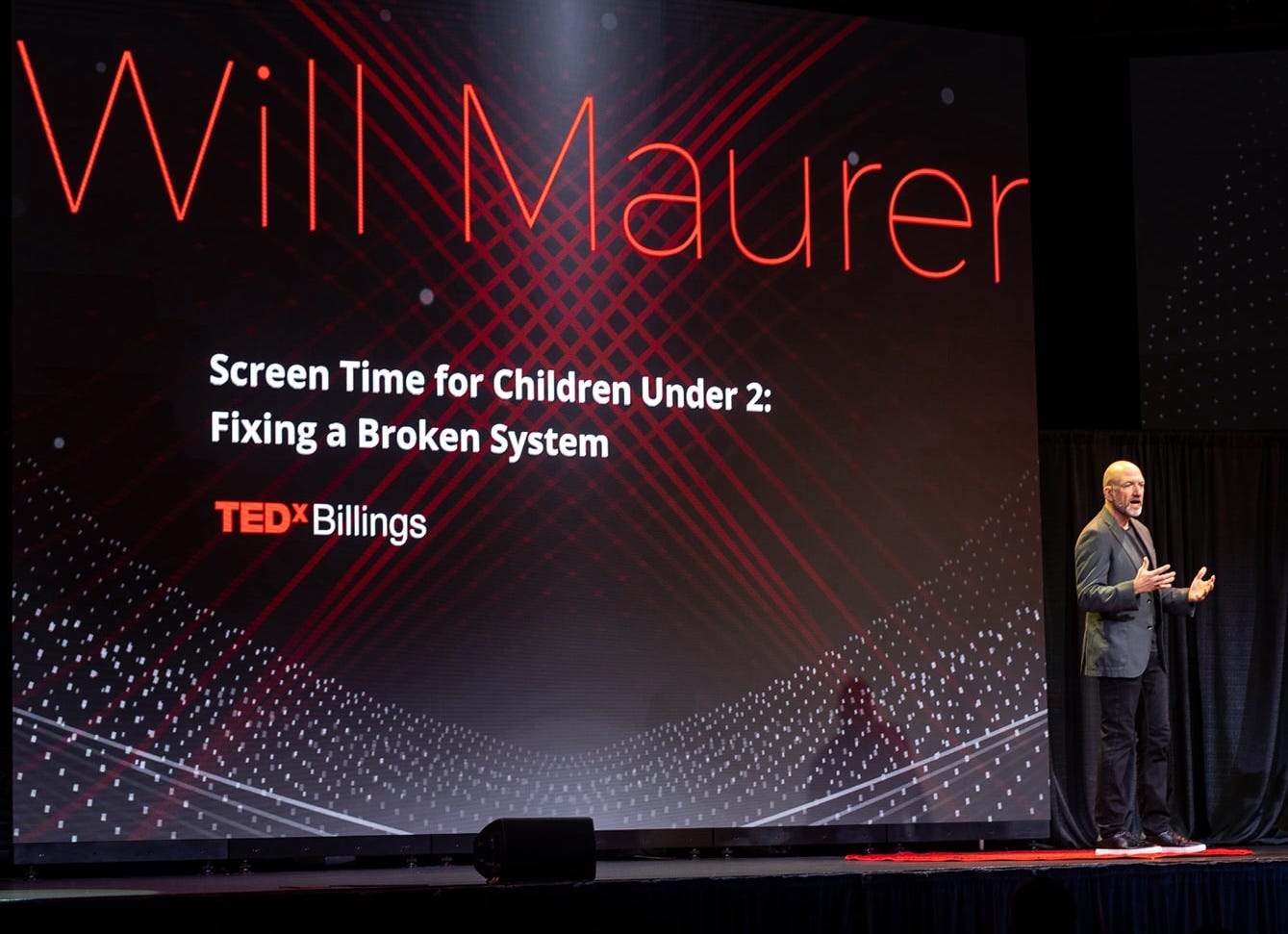
Will Maurer TEDx Transcript
Screen Time for Children Under 2: Fixing a Broken System

Will Maurer - TEDx Transcript with Source Links
“Screen Time for Children Under 2: Fixing a Broken System”
Will Maurer is the Executive Director of the Children’s Media Research and Reform Lab, a nonprofit that delivers research, tools and resources to support early years digital literacy and wellbeing for parents and practitioners. As a veteran media executive and industry insider, Will specializes in bridging the gap between developmental science and digital literacy for the early years.
TRANSCRIPT:
Let’s talk about one of the most polarizing and unavoidable topics in modern parenting: screen time for children under the age of 2. [1, 2, 3]
From my earliest memories, screens were always on. And the cartoons that raised me, they even inspired my career. So you could imagine my shock when I became a parent and learned that screen time has been linked to cognitive, emotional, and physical health issues. [4, 5, 6]
For more than half a century this topic has been debated from playgrounds to policy statements. [7]
Do this. Don’t do that. I was paralyzed by all the noise. But there was one voice that I simply couldn’t ignore. It sounded something like this: (audio of Will’s son crying)
That tiny but powerful voice inspired a years-long mission to seek answers… and uncover the truth. I’ll never forget that moment. It was 2020, the world was in lockdown, and I had just become a new father; a title that I wear more proudly than any of my professional accolades.
Prior to that, I worked with nearly every major studio, leading teams around the world to create movie magic for some of the biggest blockbusters. A career that has required overcoming constant challenges. [8, 9]
So when I heard my son’s helpless cries, and I wasn’t able to speak his language, it became the catalyst that led me down a rabbit hole of research that solidified the importance of every decision we make as parents. Some things were obvious. And others were extremely confusing; like the research and guidelines on screen time for children under the age of two.
Now remember, this was the height of the pandemic. It was just me, my wife, and our new baby. Did I mention the colic? It was constant. We were physically, mentally, and emotionally exhausted… and we desperately needed a break.
And there it was. Right in front of us. A digital babysitter.
At that moment the storm clouds parted and a golden ray of light illuminated that 55-inch screen. But before I could even reach for that remote - the internal debate began: “I grew up on screens, as I’m sure most of us have, and we turned out alright… right?” But on the other hand - what if the experts are right?
So when it came time to make a decision about screen time for our 6-month old we persevered and continued to search for answers. And although most of the information seemed contradictory and confusing, there was one thing that was NOT debatable: No screen time before the age of 2. Nearly ALL global health organizations stood in solidarity on this. And the repercussions… seemed pretty serious. [10, 11, 12, 13, 14, 15, 16}
But NO screen time? This did not seem in-line with reality. And as it turns out, we came across dozens of published reports confirming that the vast majority of children under 2 are growing up on screens. The average starting age - four months. And cohort studies from across the globe showed that 3 out of 4 infants begin watching television before their first birthday, averaging nearly an hour per day by six months old. [17, 18, 19, 20, 21, 22, 23, 24, 25, 26, 27, 28]
Some are quick to point a finger and call this a parenting failure. But the more we read the more we were convinced that this was a systemic failure. Starting with the research on this topic - which some experts refer to as a hot mess. And after nearly a year of severe sleep deprivation, so were my wife and I. But we kept on searching and were surprised to find studies showing just how flawed the existing research on this topic is. [29, 30, 31, 32, 33, 34, 35]
For instance, the American Psychological Association reviewed all publicly available policy statements and discovered a long list of issues that were fairly significant. They found that the majority of research had overstated the evidence for harmful effects, while completely ignoring conflicting evidence that certain types of content may actually be beneficial. [36, 37, 38]
This report was published over 6 years ago and has not done much to change the way these policy statements are drafted and communicated to the public. Because simply saying ‘screen time is the problem’ - and ‘NO screen time is the solution’ - is a statement that fails to look at parenting as a whole. Studies confirm that screens are being introduced earlier and more often - and for a number of different reasons. [39, 40, 41, 42]
Which is why it’s so important that parents have access to age-appropriate options. But even the mere suggestion of developing research-informed content for a 6-month-old is enough to draw the wrath of the gatekeepers and the ire of the experts. But why? It’s because flawed research has led to rigid policies that have discouraged support and funding for more relevant research and solutions. This has created a void that’s been filled with developmentally inappropriate content. Most research uses content that is already known to be harmful when they study this topic. [43]
And as for the experts - they suggest that if children under 2 engage in screen time, parents should choose quality programming like PBS Kids. But here’s the problem. PBS Kids doesn’t develop any content for children under 2. No funding. No research. Nothing that is age-appropriate. [44, 45, 46]
And then there’s the wild west of YouTube, where parents can easily find thousands of unregulated shows labeled “baby-safe” and “educational.” But does anyone even know what those terms actually mean? I didn’t. But here’s what I found: The FCC’s criteria for labeling children’s media as educational is so vague, even their own commissioners debated whether it was purposely deceptive. This lack of a clear definition only benefits the media companies. [47, 48, 49]
And nothing shocked me more than what I discovered next. It turns out, children’s media isn’t just by chance a convenient babysitter, it’s a well-oiled machine, engineered using techniques known to hijack a young child’s developing brain. But don’t take my word for it. In a NYT interview with the company behind CoComelon and dozens of other popular preschool shows, they shared insights on their production techniques, which have helped their shows reach 100’s of millions of subscribers and nearly 1 trillion views. One of the research tools they used is called “The Distractatron”. Its purpose? To make sure that a child’s attention never leaves the screen. [50, 51]
Have you ever tried to talk to a child while they’re watching one of these shows, or even worse, tried to turn it off? It’s frightening.
Just turn on any preschool show and you’ll see these same production techniques on full display. This includes:
Rapid sequencing
Frenetic action
Disorienting camera movements and cuts
Overstimulating audio and visual effects
An explosion of colors
Characters, language and concepts that a young child can’t comprehend
And an endless stream of sensory overload
Have you ever wondered why nearly all children’s media contains these elements and techniques? It’s because they’re addictive. [52]
Research shows that when a young child is exposed to this level of stimulation, it triggers dopamine imbalances that may affect the brain in a similar manner to drug addiction. These techniques precondition the mind to expect high levels of stimulation, which keeps a young child hooked and longing for more. Because the truth is… it’s impossible for them to find this level of stimulation anywhere else. This results in symptoms of withdrawal, a decline in executive function, and may lay the foundation for other addictions later in life. [53, 54, 55]
But in order to comprehend why these techniques are so powerful, we need to understand how a young child’s brain functions and develops. 80% of brain development happens in the first three years. These experiences shape the foundation for all future learning, behavior, and health. If the neural pathways are formed by periods of excessive stimulation, they can have severe adverse effects that hinder a child throughout their lifetime. The younger the child - the more consequential the effects and outcomes. [56, 57, 58, 59]
This hit me hard. My career started in the field of children’s animation… and I was completely blindsided. I felt complicit - but I refused to be complacent. So instead of continuing to ask the experts for advice, I was now demanding answers.
I wanted to know why nearly all children’s media contains overstimulating elements and production techniques that are known to be harmful?
Why does so much flawed research neglect to account for this?
Why do the most trusted organizations that parents turn to for advice on this topic, fail to factor this into their recommendations and guidelines?
And why do the systems that were designed to guide families and protect children - enable harmful content to thrive, while blocking support for more mindful alternatives?
Brain science has shown just how damaging these elements and techniques can be, so ignoring this feels negligent, and deceitful. [60, 61, 62]
Because for children around the world - screen time has simply become unavoidable.
Relatives, siblings, caregivers - there’s a community of influence that is difficult for a parent to control. And then there’s the effects of our own screen usage. The odds are truly stacked against babies from day 1. Which is why it’s so important that parents have access to age-appropriate options.
I’m not saying this to shame, or provoke anxiety. This is a call to reimagine the system. To stop ignoring the facts. And start fixing what we know is broken. [63]
After years of research - my wife and I have made this our mission. We believe that in order to combat the harmful effects of screen time - we need to eliminate the harmful elements. But what we’ve come to realize is that actions speak louder than words. So here’s a short example of what we believe research-informed content for an infant could look and sound like.
THE BABBLES RESEARCH DEMO
This demo showcases a prosocial play-based activity that illustrates problem solving, creativity and critical thinking, and engages the viewer in these activities. It emphasizes social-emotional learning through facial expressions, body language and vocalizations - the natural language of infants. It incorporates:
Turn-based play and repetition - because we know that repeated actions lead to greater retention
Symbolic gestures and baby sign language - to break down the communication barrier
Diverse characters and inclusive themes - reflecting the citizens of the world
Sounds and actions that are grounded in reality
A Watch & Play co-viewing guide - to help parents bridge the lessons from the screen to their home
And in this entire episode there’s no camera movement or cuts.
We created this example to progress the conversation from the theoretical to the evidence-based. And what we’ve observed has been quite rewarding. By eliminating the harmful elements, and focusing on activities that a parent can replicate with their child, we are observing active participants as opposed to hijacked viewers. [64]
But this shouldn’t be surprising. The late great Fred Rogers had already laid the foundation for this model over 50 years ago when he developed similar principles rooted in empathy, education and respect for the developing mind. In fact, Mr Rogers felt so strongly about this that he stood before congress to fight for the future of children’s educational media.
These are the types of actions that are necessary to create real, and meaningful change. Because our youngest and most vulnerable - they’re counting on us to band together and continue this fight, until we get it right - and even more so now than ever. Because it truly takes a village - or should I say, “a Neighborhood” - to transform a broken system.
THANK YOU!
Sources:
[7] Annual Review of Developmental Psychology Children and Screens
[10] Correlates of screen time in the early years (0–5 years): A systematic review - PMC
[11] WHO: guidelines on physical activity, sedentary behaviour and sleep for children
[14] Screen use by children aged under five: independent report - GOV.UK
[15] New screen time guidance for parents of under-5s - GOV.UK
[23] The Immediate Impact of Different Types of Television on Young Children’s Executive Function
[24] Infant Television Watching Predicts Toddler Television Watching in a Low-Income Population - PubMed
[25] High amounts of screen time begin as early as infancy, NIH study suggests
[26] Average Amount of Screen Time for Children and Young Adults
[28] Language learning in a digital world: How screen time impacts children’s language development
[29] Reconsidering Screen Time: Research, Reason, & Real Life | Lucie’s List
[30] How Much Does Screen Time Really Affect Child Development?
[31] Correlates of screen time in the early years (0–5 years): A systematic review - PMC
[34] Reconsidering Screen Time: Research, Reason, & Real Life | Lucie’s List
[35] The Truth About Research on Screen Time - Dana Foundation
[38] Are Some Types of Screen Time Better Than Others? | Common Sense Media
[39] ‘I’m not perfect’: Navigating screen time among parents of young children during COVID‐19 - PMC
[40] High amounts of screen time begin as early as infancy, NIH study suggests
[41] Global Prevalence of Meeting Screen Time Guidelines Among Children 5 Years and Younger
[44] Media and Young Minds | Pediatrics | American Academy of Pediatrics
[48] STATEMENT OF COMMISSIONER JESSICA ROSENWORCEL, DISSENTING
[49] Weakening TV Programming Rules, GOP-Controlled FCC Throws Kids Under the Bus | Common Dreams
[50] Moonbug’s ‘CoComelon’ Leaves Nothing to Chance - The New York Times
[51] How CoComelon Captures Our Children’s Attention | The New Yorker
[52] Digital Addictions: A Family Guide to Prevention, Signs, and Treatment - Children and Screens
[55] What Screen Addictions and Drug Addictions Have in Common
[56] Brain Architecture: An ongoing process that begins before birth.
[59] Brain Development Series, Part I - Children’s Institute
[63] Too much screen time harms children, experts agree. So why do parents ignore them?
[64] Do infants understand educational television content based on scientific findings? - ScienceDirect
Great presentation! Now I want to see more demo videos. Crucial research info delivered in a very personal way with suggestions for how to fix the problem. I know Jon Haidt would like to see this.